A Retablo by Nicario Jiménez

Dr. Maria Fernanda Boza Cuadros über einen Neuzugang in der Sammlung Zentral- und Südamerika

Im Juli 2026 konnte das Museum Fünf Kontinente mit Eigenmitteln ein Retabel von Nicario Jiménez aus Privatbesitz erwerben. Im Blogbeitrag stellt Kuratorin Dr. Maria Fernanda Boza Cuadros das Objekt und dessen historische Bedeutung vor und ordnet es in das Œuvre des peruanischen Künstlers ein.

Retablos in historical perspective

Retablos date back to the Spanish colonial era, and for centuries functioned as portable altars and Christmas scenes. They originally served as devices to further the forced Christianization of Indigenous Andeans, although the latter found in them a medium for artistic expression and a reinterpretation of narrative and artistic conventions within the colonial imaginary. Retablos became quite popular as an artistic practice in the central highlands of Peru, notably in the region of Ayacucho. In many cases artists belong to families who have been making retablos for generations. Throughout the centuries, retablos have continued to depict religious motifs, and they started depicting scenes of secular life during the 20th century. Another retablo in our collection, 2021-13-1, for example, depicts a scene of the Yawar Fiesta, a feast from the central highlands of Peru that symbolizes the struggles under and liberation from Spanish oppressors. In this retablo scene, the condor of the Yawar Fiesta is killing the bull as people around the fighting animals play music, sing, and hold the animals at the center of the scene. A second condor awaits for the first to liberate itself and fly away together. This retablo, made before 1995, is by Claudio Jiménez, one of Nicario Jimenez’s brothers and also a retablo artist himself. Nowadays retablos are quite common as souvenirs.

Artists from Ayacucho utilized the retablo as a medium to show the violence of the Internal War (1980-2000) from the perspective of Indigenous communities. In the 1970s a Maoist guerrilla group, Sendero Luminoso (Shining Path), emerged in Huamanga, the capital city of Ayacucho, under the leadership of Abimael Guzmán Reynoso. They began armed actions against the Peruvian state during the first democratic general election after the military dictatorship of 1968-1980. The central government in Lima ceded control of Ayacucho and other provinces of the central highlands to the armed forces in 1982. What followed were years of relentless violence, displacement, abuses and enforced disappearances committed by both Sendero Luminoso and the Peruvian armed forces. Retablos produced at this time privileged the plight of Indigenous communities, who were otherwise consistently misrepresented in the press and forgotten by the state and the church.
Biographical sketch of Nicario Jiménez Quispe

Nicario Jiménez Quispe was born in the village of Alcamenca in Ayacucho, Peru in 1957. He studied anthropology and sculpture at the Centro de Capacitación Artesanal de Huamanga, the Universidad Nacional San Cristóbal de Huamanga, and the Universidad Nacional Mayor de San Marcos. He is a fourth generation retablo maker. He fled Ayacucho in the 1980s, when the violence spurred by the Maoist guerrilla Sendero Luminoso and the abuses of the Peruvian Armed Forces pushed his family and thousands of other families to escape. The Jiménez family settled in Lima, where they produced retablos as means of economic survival. He traveled often between Peru and the United States in the 1980s, until finally establishing himself in Naples, Florida where he currently resides.

2026-28-1

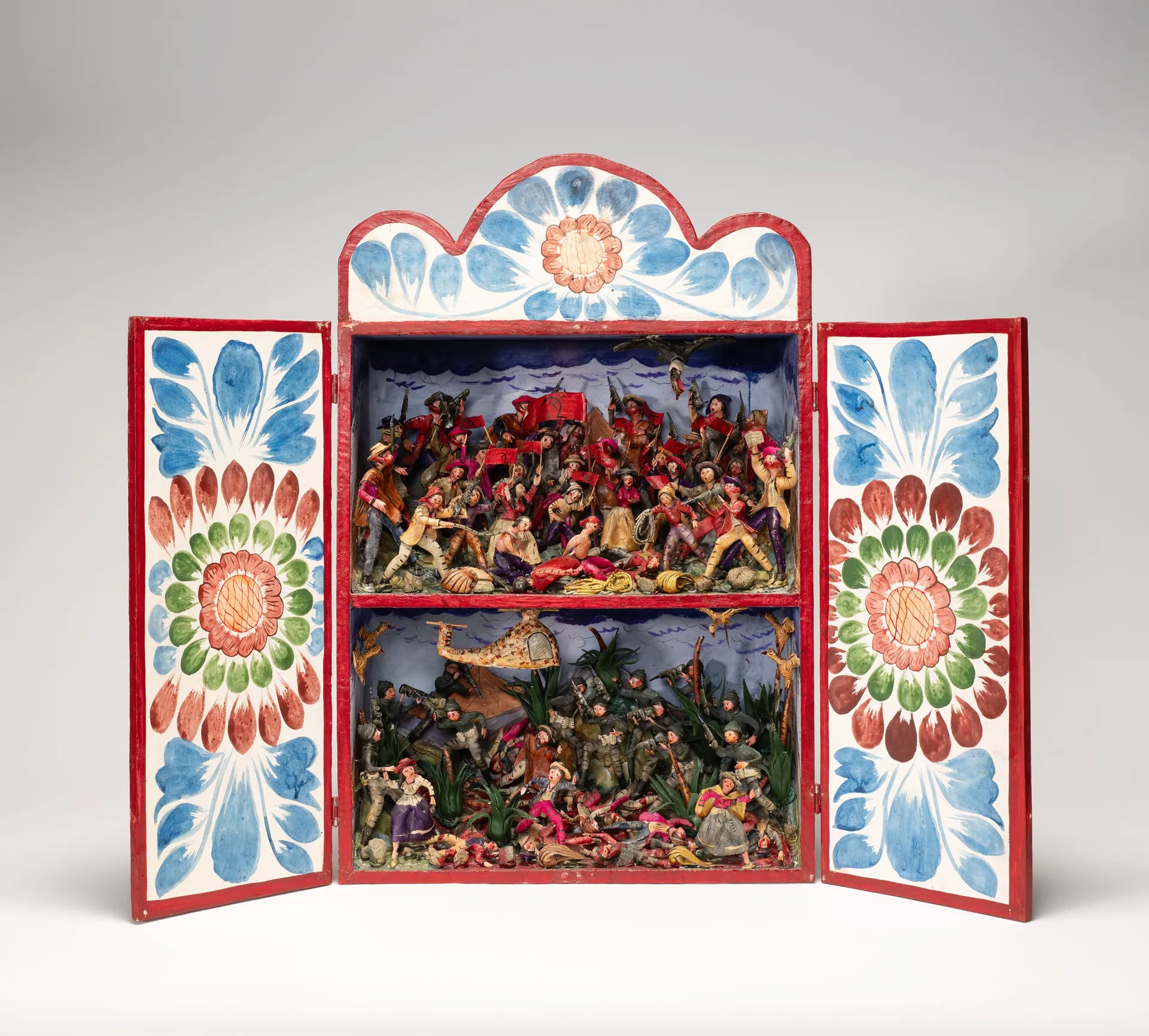
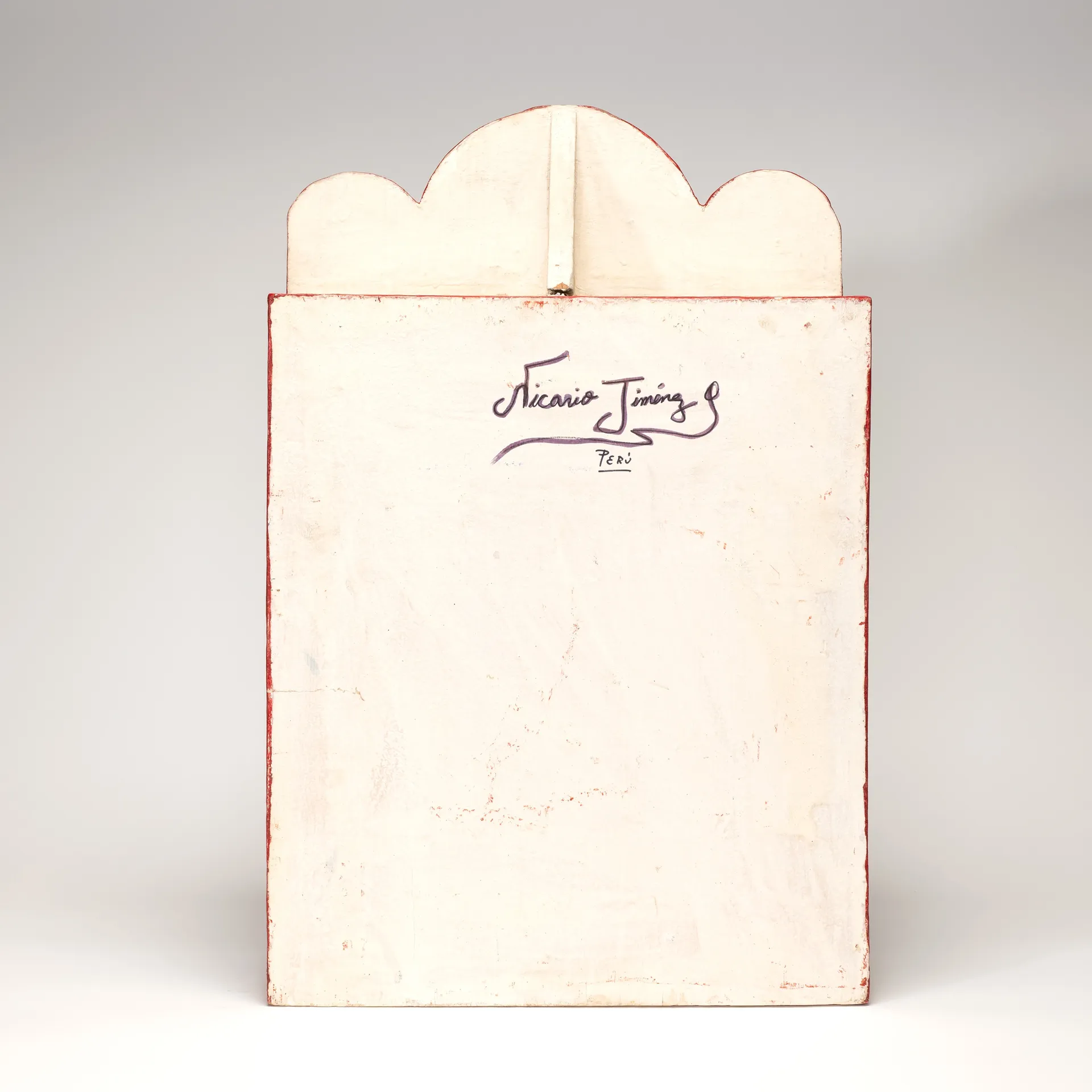
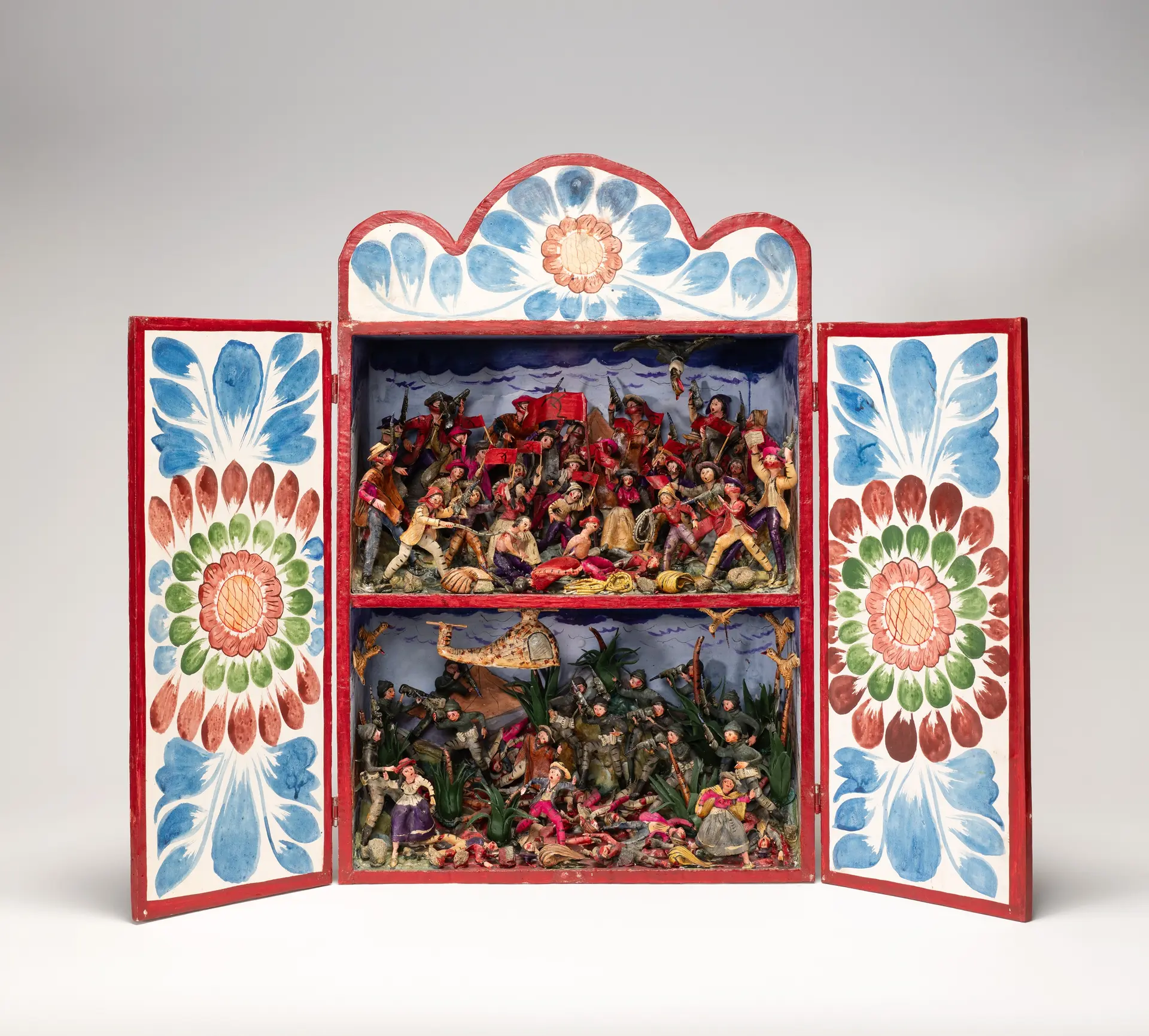
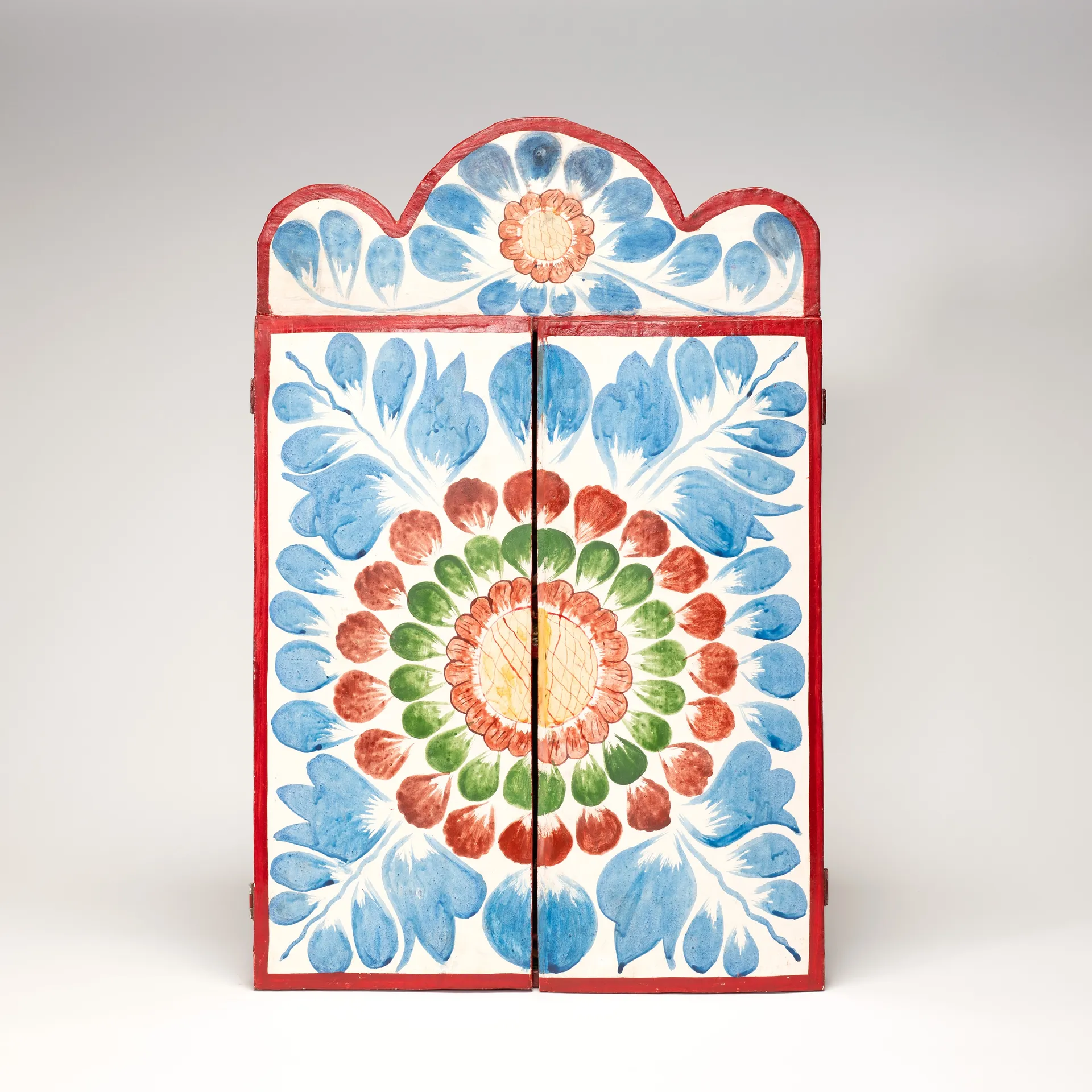
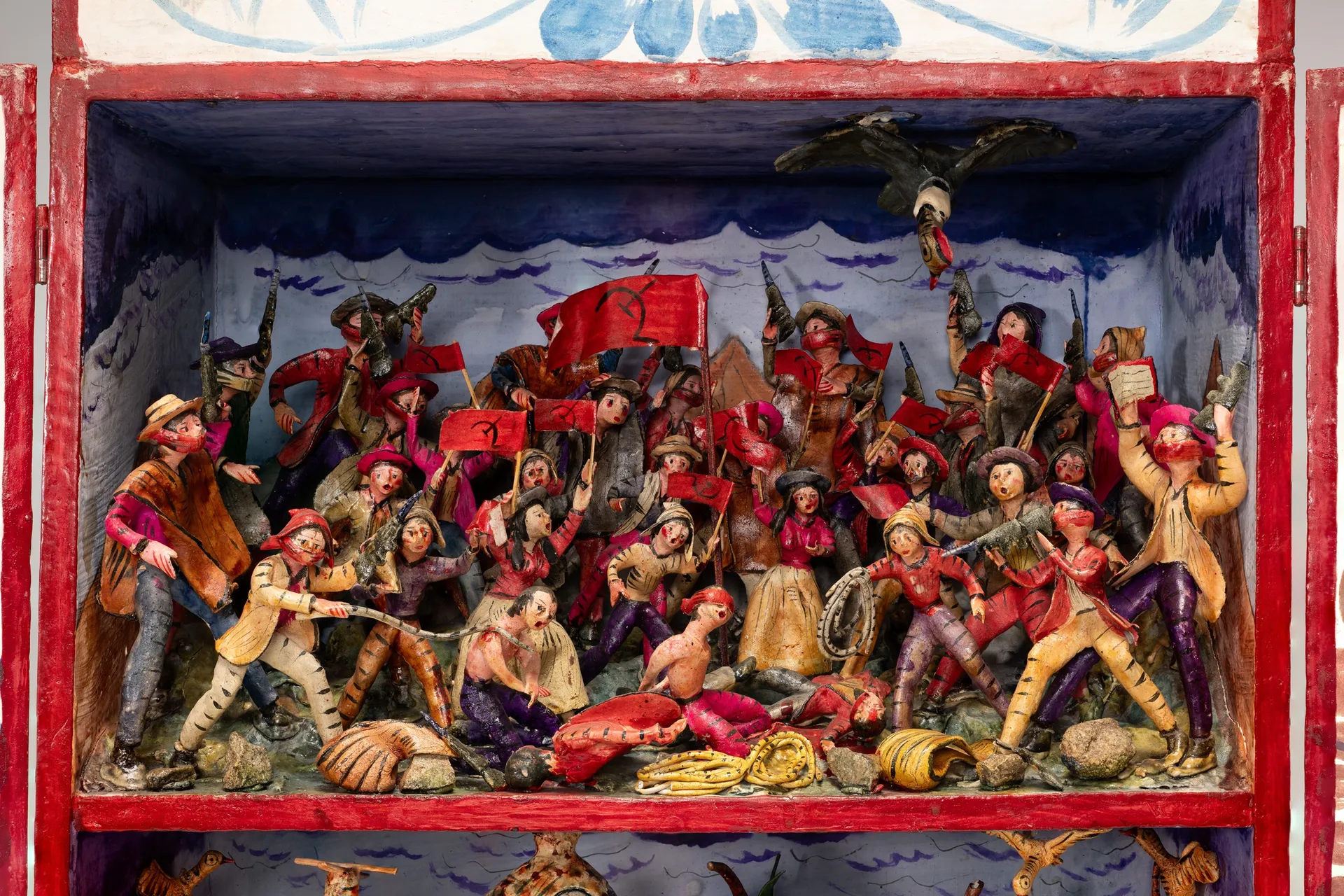
The retablo by Nicario Jiménez Quispe was acquired by Museum Fünf Kontinente in July 2026. It measures 65 x 42,3 x 18,8 cm. The box, doors and top of the retablo are made out of wood, and the figures inside are made of a mix of gypsum and boiled potatoes. Stylistically, 2026-28-1 follows all standard retablo conventions: modeled figures in the scenes, scenes that privilege a horizontal layout, and painted floral decorations inside and outside the doors and on the outside of the box. The scenes are dynamic and the figures therein are rather expressive, a style consistent with the artistic production of the Jiménez Quispe brothers.

The pediment, and the inside and outside of the doors are decorated in red, green, orange and blue flowers and blue leaves above, below and to the sides of the flowers. The interior of the retablo box is split horizontally in two registers, each with a different scene. Both scenes take place outside in open air. The top scene depicts a group of armed peasants holding red flags with the sickle and hammer, imagery that signals that these are members of the Maoist guerrilla Sendero Luminoso. Their attire of ponchos and other dress common in the Andes shows these guerrilleros are also Andean themselves. Only some of them carry weapons. The senderistas have captured several men in this scene. One of these latter men is half dressed, hands tied behind his back, and eyes covered. Another man is being whipped. The lifeless bodies of two other men lie on the ground on the right side of the scene and between the two still living prisoners. A condor observes the scene from the sky. The scene is reminiscent of episodes when Sendero Luminoso members would descend onto Indigenous peasant villages, capture the leaders, round up the town’s population in the main square, put authorities through a »popular trial«, and lastly conduct punishment, usually killing them after public whippings and other corporeal punishments.

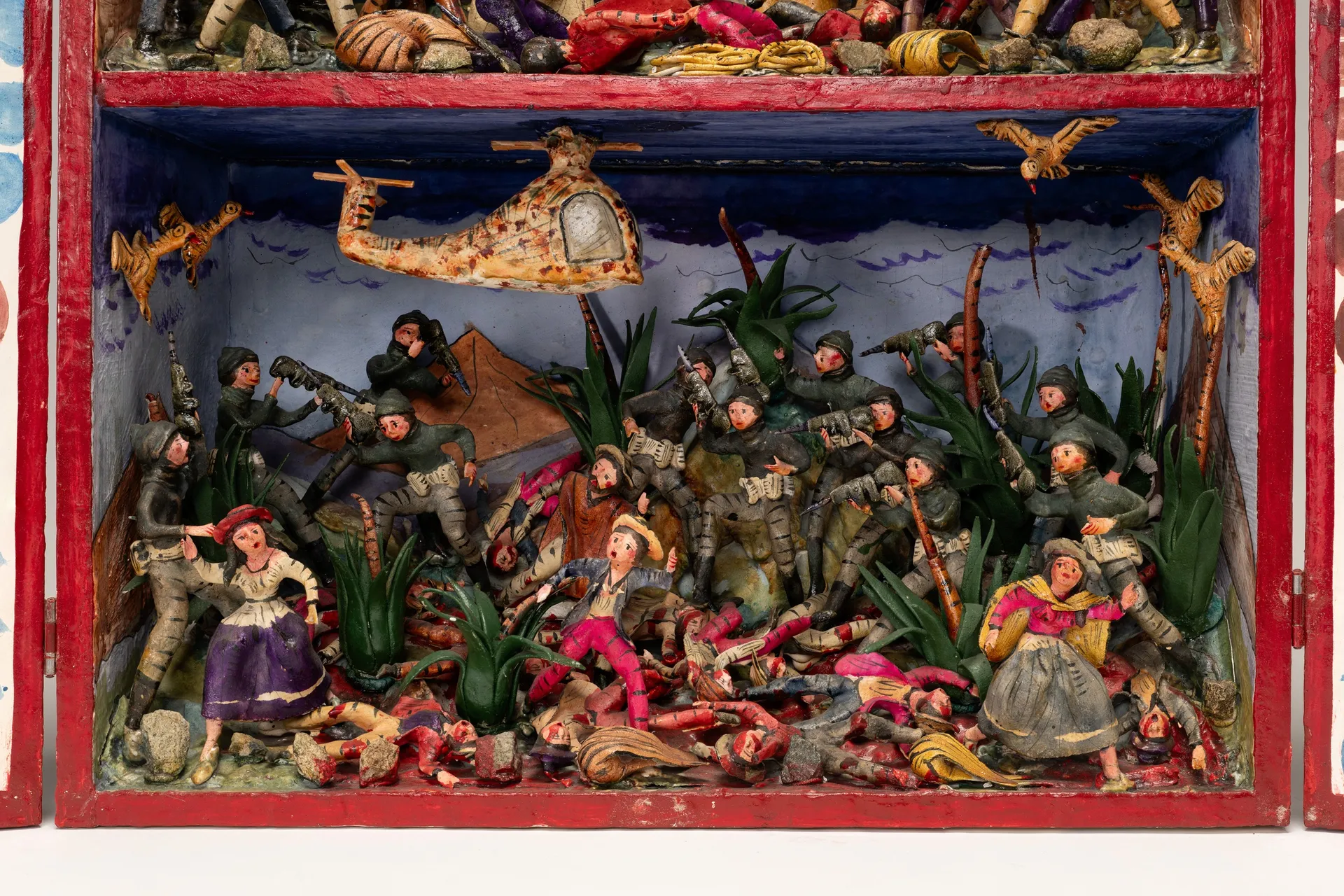
The lower register depicts the violence of the Peruvian armed forces against Indigenous peasants, although it is unclear which is being depicted. Both the army and the navy conducted anti-terrorist operations in Ayacucho, and parties in both have been found responsible for abuses against the civilian population. The members of the armed forces can be recognized by the uniforms they wear: camouflage-patterned pants, green turtle neck sweaters and black knit caps. Most of them carry rifles. People in Indigenous clothes are at the center of the scene suggesting that the troops have descended and opened fire onto them. Two women and two men are fleeing, and several peasants lie on the ground, which is red from their blood. In conversation with Mr. Jiménez Quispe in July 2026 he shared that this retablo does not depict specific events, but instead it was created to show the persistence of violence suffered by Indigenous Andean communities from both battling parties.

Other works by Mr. Nicario Jiménez in other collections

The retablos by Mr. Jiménez portray a wide variety of themes that include and deviate from traditional Catholic imagery. Among the former is the three-tiered retablo (1982) currently at the San Antonio Museum of Art in San Antonio, Texas. The top register of this retablo depicts a group of prayers and musicians before a crucifixion flanked by angels. The middle register depicts a nativity scene surrounded by dancers and musicians, and the bottom of the register shows the interior of a Luthier’s workshop. Another retablo with a Christian theme is currently in the James and Emilia Govan Crèche Collection of Loyola University, Chicago. In this case, the single-register altar depicts a scene of adoration of the magi.

Jimenez’s political retablos tackle on history as much as contemporaneous events as testimonies of colonialism, exploitation and violence. In El Pistaku, currently in the Lowe Museum of Art at the University of Miami, Jiménez utilizes the three vertical levels to narrate figures associated to the pistaku (also pishtaco or pishtaku), a foreign white man that exploits Indigenous people by extracting their body fat. In the Miami work, the registers represent the pistaku from top to bottom as a Franciscan missionary, a white man known to decapitate Indigenous people and as a white foreign military agent, respectively. The instability and widespread protests of the 1980s and 1990s are represented in a retablo in the Spurlock Museum of World Cultures at the University of Illinois in Urbana-Champaign. Lastly, this retablo in the Ruth and Elmer Wellin Museum of Art at Hamilton College shows the capture of Abimael Guzmán, leader of Sendero Luminoso on 12 September, 1992.

Historical significance of the object

During and after the years of the Peruvian Internal War (1980-2000), retablos became a medium to depict the abuses and violence of the period. The use of the retablo in this context is no coincidence, as Sendero Luminoso formed first in the city of Huamanga (Ayacucho), and the city and its hinterland were the most deeply affected by the violence of both the guerrilla and the Peruvian armed forces. Importantly, the retablo became a medium in which victims themselves could narrate their experiences through works that were not limited by language or the emotions of the oral narrative. Retablos have been used in the exhibition of the Museo de la Memoria in Ayacucho, a museum created by ANFASEP (Asociación Nacional de Familiares de Secuestrados, Detenidos y Desaparecidos del Perú or National Association of Relatives of Kidnapped, Detained, and Disappeared Persons in Peru) in the city of Ayacucho.

Furter readings

Informe Final de la Comisión de la Verdad y Reconciliación, Perú. Link

Selected scholarly sources

Cercato, Clara Belén. Retablo Ayacuchano: De Medio de Evangelización a Expresión Artística Popular Andina. 5° Jornadas Estudiantiles de Investigación en Disciplinas Artísticas y Proyectuales: Trayectos, Reflexiones y Experiencias. 2022. Link

Damian, Carol, Michael J. LaRosa, and Steve Stein. Immigration in the Visual Art of Nicario Jiménez Quispe. Foreword by Annette B. Fromm. (Lanham, MD: Rowman & Littlefield, 2019. Pp. xii + 131, acknowledgments, illustrations, bibliography, index.). Link

Quiroz, Víctor.  Políticas andinas de la memoria. El conflicto colonial peruano en el retablo ayacuchano El hombre (1987) de Edilberto Jiménez Quispe. Hispanic Issues On Line 2016, 17: pp. 17-104. Link

Ulfe, María Eugenia. Representaciones del (y lo) indígena en los retablos peruanos. Bulletin de l’Institut Français d’Études Andines, 2009, 38 (2): 307-326. Link

Ulfe, María Eugenia. "Three. Narrating Stories, Representing Memories: Retablos and Violence in Peru". Art from a Fractured Past: Memory and Truth-Telling in Post-Shining Path Peru, edited by Cynthia E. Milton, New York, USA: Duke University Press, 2014, pp. 103-124. Link

Ulfe, Maria Eugenia. Cajones de la memoria. La historia reciente del Perú a través de los retablos andinos. Colección Estudios Andinos, Fondo Editorial de la Pontificia Universidad Católica del Perú, 2022, Lima. Link

Popular press

Retablos in Condé Nast

Profile of Nicario Jiménez in Gulf Shore Life

Claudio Jiménez on BBC